
At Gatetouch, we’ve spent the past year building these systems for clients across Europe, and we’ve watched the conversation change from “can AI actually do this reliably?” to “how quickly can we get this running in our business?” This article explains what an AI agent actually is, where the technology is already delivering real results, what a responsible rollout looks like, and how to think about whether your business is ready to start.
What Exactly Is an AI Agent, and Why Does It Matter Now?
An AI agent is a software system built on top of a large language model that is given a goal, access to a set of tools or APIs, and the ability to reason through the steps required to reach that goal. Instead of a human specifying every click and every condition, the agent itself decides what needs to happen next based on the current state of the task. This is a meaningful step beyond the kind of generative AI for business automation that most companies adopted over the past two years, where a person still had to prompt the system for every individual output. A traditional rule-based automation tool can only handle the exact scenarios its developers anticipated in advance, while an agent can handle variation, ambiguity, and multi-system coordination that would previously have required a person sitting at a keyboard.
The timing of this shift isn’t accidental. The language models powering these agents have become dramatically more reliable at reasoning and tool use over the past year, the cloud infrastructure needed to run them has become significantly cheaper, and integration standards between business software platforms have matured to the point where an agent can realistically call dozens of different tools inside a single workflow. Together, these developments have moved agentic AI from an experimental concept into a practical technology that mid-sized companies can deploy on a reasonable budget and a realistic timeline — which is a large part of why, as we noted in our look at why European SMEs are investing in business automation in 2026, this has become a board-level priority rather than a back-office experiment.
Where European SMEs Are Already Applying AI Agents
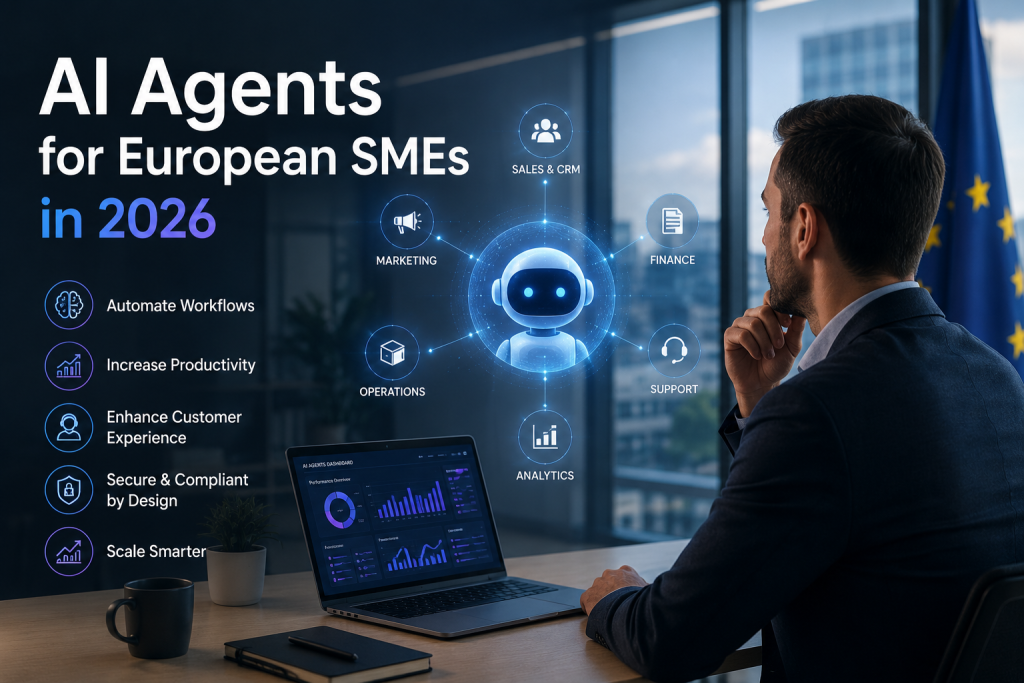
Across the clients we work with, agentic automation has taken hold in a handful of clear, high-value areas rather than being spread thin everywhere at once. In customer operations, agents now handle the full lifecycle of a support ticket — reading the incoming message, checking order history inside the CRM, drafting a response, applying a refund within pre-set limits, and escalating only the cases that genuinely require a human judgment call. In finance and back-office work, agents reconcile invoices against purchase orders, flag discrepancies, and prepare draft entries for approval rather than requiring a finance team member to do this manually every single day.
Sales and marketing teams are another area of rapid adoption, where agents research incoming leads across public data sources, score them against ideal customer criteria, and populate the CRM with enriched, ready-to-use information before a salesperson ever picks up the phone. In IT operations, agents increasingly monitor system logs, detect unusual patterns that might indicate a security issue or a performance bottleneck, and take a first line of corrective action automatically — an extension of the kind of proactive protection we described in AI-powered cybersecurity in the cloud. What ties all of these use cases together is that the agent isn’t replacing the judgment of skilled staff; it’s absorbing the repetitive, well-defined portions of a workflow so people can focus on the parts of the job that genuinely require human expertise.
The Business Case: Why This Is Worth Investing In Now
The financial argument for agentic automation becomes obvious once you look at where time actually goes inside a growing business. A significant share of administrative and operational hours is spent on tasks that are repetitive, rules-based, and scattered across multiple disconnected software tools — precisely the kind of work an AI agent is designed to absorb. Companies that have implemented agentic workflows in customer support and finance operations commonly report reductions in manual processing time in the range of 30 to 50 percent for the specific workflows involved, along with faster response times to customers and fewer errors caused by manual data entry.
There’s a competitive dimension here too. As more companies in an industry adopt agentic automation, the businesses that don’t adapt increasingly find themselves at a cost and speed disadvantage against competitors who can respond to customers faster, process orders with fewer delays, and reallocate human talent toward growth-oriented work instead of administrative overhead. For SMEs specifically, this is a rare opportunity to close the operational gap with larger enterprises that have historically had bigger teams and bigger budgets, because a well-designed AI agent can now perform work that once required several full-time employees — much the same shift we’ve seen play out with low-code and no-code platforms lowering the barrier to building custom internal tools without a large in-house development team.
What a Responsible AI Agent Implementation Actually Looks Like
It’s worth being direct about the fact that not every business is ready to hand an AI agent full autonomy over sensitive processes on day one, and a responsible implementation partner should never suggest otherwise. Our approach to building agentic systems follows a staged model that starts with the agent operating in a supervised mode, where it drafts recommended actions — a refund, an email response, a data update — but a human reviews and approves each one before it takes effect. As confidence in the agent’s accuracy builds over weeks of real-world operation and monitoring, we gradually expand its autonomy to lower-risk categories of decisions, while keeping human oversight in place for anything involving financial thresholds, legal exposure, or customer-facing communication that could affect the brand.
This staged approach matters just as much from a compliance perspective as it does from a risk-management one. For businesses operating in Europe, any AI system that processes personal data, makes decisions that materially affect individuals, or operates within regulated industries such as finance or healthcare needs to be designed with GDPR compliance and the EU AI Act’s risk-based obligations in mind from the very first line of code, not retrofitted afterward. This includes maintaining clear audit logs of every action an agent takes, ensuring there is always a mechanism for a human to intervene or override a decision, and being transparent with customers about when they’re interacting with an automated system rather than a person.
How Gatetouch Approaches AI Agent Development for Our Clients
When a client comes to us wanting to explore agentic automation, we start with a discovery phase focused on identifying the specific workflows where the volume of repetitive work is high, the decision logic is well understood, and the cost of an occasional error is manageable — since these are the conditions under which an AI agent delivers the fastest and safest return on investment. From there, our development team designs the agent’s toolset, meaning the specific APIs and system integrations it will be given access to, and builds in the guardrails, approval steps, and logging that keep the system auditable and controllable, following the same rigorous standards we apply across our custom software development work.
Because Gatetouch also builds the CRM and ERP systems, custom platforms, and cloud infrastructure that many of our clients already run their operations on, we’re frequently able to connect an AI agent directly into the same systems we’ve already developed, which significantly shortens the integration timeline compared to bringing in a third-party AI vendor unfamiliar with the client’s existing setup. If a client is building a new internal platform from scratch alongside their automation goals, we typically bring the same thinking that shaped our recent piece on how to choose the right software development partner in 2026 — namely, that the technology choice matters far less than whether the partner understands your actual operational bottlenecks. Once an agent is live, we don’t consider the project finished; we continue to monitor its decision accuracy, gather feedback from the team members working alongside it, and refine its instructions and permissions over time as trust in the system grows.
Getting Started With Agentic AI in Your Business
If your business is currently spending significant staff hours on tasks such as ticket triage, invoice processing, lead qualification, or routine system monitoring, there’s a strong chance that agentic automation could free up meaningful capacity within months rather than years. The most practical way to begin isn’t a company-wide transformation initiative — it’s a single, well-defined pilot workflow where success can be measured clearly and lessons can be applied before scaling further. If your business is still running largely on spreadsheets or disconnected point solutions, it’s often worth pairing this conversation with a broader look at your SaaS and platform strategy, since an agent is only as effective as the systems it has access to.
AI agents are not a replacement for good people or good processes — they’re a way to give both of those things room to operate at their best, by removing the repetitive work that sits between your team and the decisions that actually need their attention. The businesses that will benefit most from this shift over the next few years won’t necessarily be the ones with the biggest AI budgets, but the ones that start with a clear, well-scoped pilot, measure it honestly, and build trust in the system gradually rather than trying to automate everything at once.
Gatetouch’s team works with businesses across Europe to identify these pilot opportunities, design agentic workflows that respect data privacy and regulatory requirements, and build systems that integrate cleanly with the software you already use. If you’d like to discuss where AI agents could realistically fit into your operations, our team is ready to walk through your specific processes and outline a practical starting point.
Get in touch with our team to discuss your AI automation project